
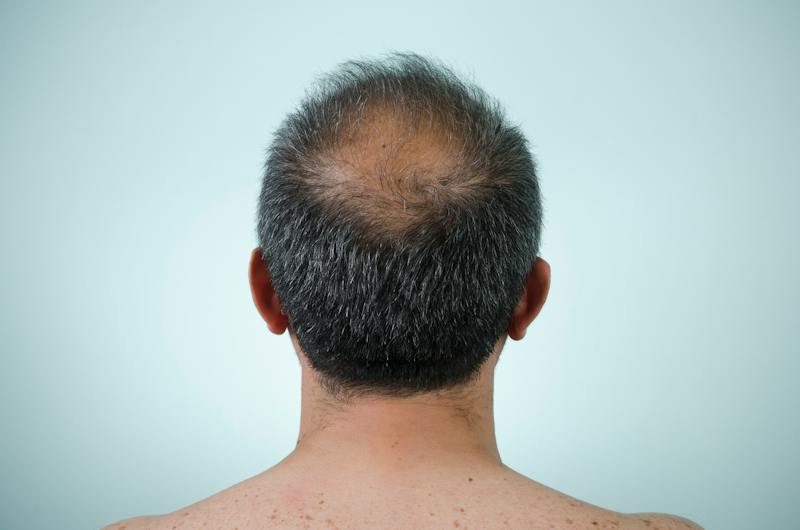
A hair transplant should not leave the back of your head looking patchy or thin when the donor area is planned carefully. The donor area is the back and sides of the scalp, where healthy hair is taken from. With follicular unit extraction (FUE), a surgeon removes only a portion of that hair and spreads the extractions out evenly. Some people notice brief shedding near the extraction sites, which usually grows back. Lasting donor area thinning after a hair transplant is mostly linked to overharvesting. A qualified hair restoration surgeon can tell you what your donor area can safely give.
Below, you’ll see what’s normal, what isn’t, and how Dr. Michael Wolfeld protects the donor area during an FUE hair transplant in NYC.
Why the back of the head usually stays full after FUE
The back of the head usually stays full after FUE because the donor area starts with far more hair than it needs to look natural. A surgeon removes only a portion of the follicular units, which are natural groups of one to four hairs, and leaves gaps spread out among the remaining hair, so the area looks even.
The numbers explain why. The donor scalp at the back of the head holds about 65–85 follicular units and 124–200 hairs per square centimeter, according to a study in Dermatologic Surgery. Hair also doesn’t need its full original density to look full. A review in the Journal of Cutaneous and Aesthetic Surgery notes that only about 50% of the original density is needed to create the look of fullness.
That margin is what lets the donor area share hair with thinning areas and still keep its own natural look.
Is thinning in the donor area after a hair transplant temporary?
Thinning in the donor area after a hair transplant is often temporary. Some patients notice shedding near the extraction sites in the weeks after surgery, a reaction called shock loss. According to a case series in the Journal of Cutaneous and Aesthetic Surgery, donor shock loss is usually temporary, with full recovery almost always seen within 3–4 months.
Shock loss is a temporary shedding of existing hair after the stress of surgery. It can look worrying at first, but it is a short-term phase, not a sign that the donor area is used up. The case series describes donor shock loss as “usually temporary, and full recovery is almost always observed in the following 3–4 months.” You can learn more about why hair sheds on our hair shedding page.
During recovery, Dr. Wolfeld is available to answer questions. He may suggest supportive treatments such as platelet-rich plasma (PRP) therapy to help healing and hair growth.
What causes lasting patchiness or a “moth-eaten” donor area?
Lasting patchiness in the donor area is mostly caused by overharvesting, which means taking more grafts than the back of the scalp can give while still looking natural. Extractions that are crowded together or uneven, and repeat sessions that add up over time, can also leave a thin or “moth-eaten” look that does not grow back.
Every follicle moved to the top of the head is no longer at the back. That’s why the donor area works like a lifetime budget, not an unlimited supply. A paper in the International Society of Hair Restoration Surgery’s journal, Hair Transplant Forum International, reports that the donor “will look noticeably thin if more than 50% of the original terminal hair is harvested” across one or more FUE sessions.
The takeaway is simple: planning matters more than graft count alone. A surgeon who spreads extractions evenly and plans for future needs can keep the back of the head looking natural.
How much hair can safely be taken from the donor area?
How much hair can safely be taken from the donor area depends on your starting density and your long-term plan. Published guidance points to conservative limits, such as keeping a first FUE session under 35% of total hair density. Researchers also note that no single formula fits everyone.
|
Benchmark |
Figure |
Source |
|
Follicular unit density in the donor area |
65–85 follicular units per cm² (124–200 hairs per cm²) |
|
|
Density needed to look full |
About 50% of original density |
|
|
Safe lifetime supply (average person) |
About 6,000 follicular units |
|
|
Suggested first-session limit |
Less than 35% of total hair density |
|
|
Suggested second-session limit |
10–20% of total hair density |
|
|
Point where donor looks noticeably thin |
More than 50% of original terminal hair harvested |
|
|
Cosmetic residual density |
More than 40 follicular units per cm² |
These figures are general research benchmarks, not a personal plan. A paper by Keene and colleagues in Hair Transplant Forum International notes that no single algorithm yet predicts the minimum safe donor density for every patient. That’s why your own donor area should be evaluated in person.
How Dr. Wolfeld protects your donor area with FUE and ARTAS iX
Dr. Wolfeld protects the donor area by harvesting follicular units randomly from the back and sides of the scalp and using the ARTAS iX robotic system for consistent, even spacing. The ARTAS iX cameras calculate hair angles, follicle depth, and donor density, which helps keep the back of the head looking natural.
The ARTAS iX system uses special algorithms to select grafts and guide precise extractions. This helps protect the donor area and maintain its natural look. You can read more about how robotic follicular unit extraction works.
FUE also leaves tiny scars spread across the scalp instead of a single line, so you can wear your hair as short as you like. A follicular unit transplant (FUT), or strip procedure, leaves a linear scar that may be visible with shorter hairstyles. FUE can be especially helpful for people whose donor areas were affected by earlier strip procedures. Patients with an existing scar can also ask about scar repair.
Dr. Michael Wolfeld runs a boutique practice focused strictly on hair restoration. He is the first hair restoration specialist in the country double board-certified in both plastic surgery and hair restoration surgery.
Who is a good candidate for FUE without risking donor thinning?
A good candidate for FUE has enough healthy follicles in the donor area to share and is medically safe for treatment. Candidates should also be non-smokers or willing to quit for a period of time, and have realistic expectations. Checking donor supply before surgery is an important step in keeping the back of the head full.
Age alone doesn’t rule anyone out. FUE can be offered to patients in their twenties or their seventies, as long as they are medically eligible. At your consultation, Dr. Wolfeld will review your hair loss and donor area to see whether FUE is the right fit. [CONFIRM WITH CLIENT: specific donor-density assessment steps used at consultation.] To see what results can look like, browse the male hair transplant gallery.
What will the back of your head look like during recovery?
During recovery, the back of the head will have a shaved harvest area with tiny extraction sites that heal quickly. FUE does not use scalpels, stitches, or staples, and most patients return to normal activities within a few days. New hair usually appears within three months, with full results in a year or longer.
The harvest site is shaved before surgery so each follicular unit can be removed precisely. Because the extraction sites are small, they heal quickly, and any minor discomfort can usually be managed with over-the-counter pain relief. On the top of the scalp, significant new growth typically shows after six months. Full results can take a year or longer.
Frequently Asked Questions
Does hair grow back in the donor area after FUE? Hair that was shaved or briefly shed in the donor area grows back, while the follicles that were moved now grow in their new location. Donor shock loss is usually temporary, with full recovery almost always seen within 3–4 months, according to the Journal of Cutaneous and Aesthetic Surgery. Careful, spread-out harvesting keeps the area looking natural.
How long does shedding at the back of the head last after a hair transplant? Shedding at the back of the head after a hair transplant usually lasts a few months. Research in the Journal of Cutaneous and Aesthetic Surgery reports that donor shock loss is usually temporary, with full recovery almost always observed within 3–4 months. If shedding concerns you, your surgeon can check your progress and suggest supportive options.
Can I have a second FUE procedure without thinning the back of my head? A second FUE procedure is often possible when the first session left enough donor reserve. Published guidance in the World Journal of Plastic Surgery suggests limiting a second session to 10–20% of total hair density. Your surgeon should track what has already been taken and plan future sessions around your lifetime donor supply.
Will the tiny FUE scars be visible with a short haircut? FUE leaves tiny scars spread across the back of the scalp rather than one linear scar, so you can wear your hair as short as you like. A strip (FUT) procedure, by comparison, leaves a linear scar that may be visible with shorter hairstyles. Ask your surgeon how your donor area is likely to look at your preferred length.
Can a thin donor area from a previous transplant be improved? A donor area thinned by a previous transplant can sometimes be improved, depending on how much healthy hair remains. Dr. Wolfeld offers scar repair, and FUE can be especially helpful for people whose donor areas were affected by earlier strip procedures. A consultation is the best way to see which options fit your scalp.
How does a surgeon decide how many grafts to take from my donor area? A surgeon decides how many grafts to take by weighing your donor density, the size of the area to cover, and how much hair you may need in the future. Researchers note that no single formula fits everyone, so the number should be personal. The goal is to leave enough hair for the back of the head to look full.
The Bottom Line
A hair transplant should leave the back of your head looking natural when the donor area is planned with your future in mind. Brief shedding can happen and usually grows back. Lasting thinning is tied to overharvesting. A qualified hair restoration surgeon can assess your donor supply and set realistic expectations. Explore FUE hair transplant with Dr. Wolfeld, then schedule a consultation at his Park Avenue office in New York City or book a virtual consultation.