
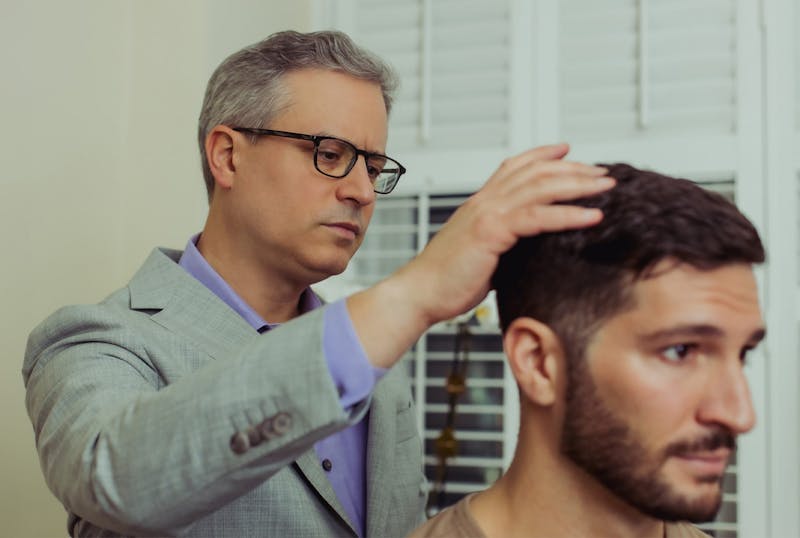
If you're researching hair restoration, you've likely encountered three primary techniques: robotic FUE, manual FUE, and FUT. So, what's the difference, and which option is best?
The answer depends on your hair characteristics, degree of hair loss, donor supply, aesthetic goals, and personal preferences. In general, both FUE and FUT can produce excellent, natural-looking results when performed by an experienced surgeon. FUT may offer advantages for patients requiring large graft counts in a single session, while FUE eliminates the linear scar associated with strip harvesting. Robotic FUE builds upon traditional FUE by incorporating advanced machine vision and robotic precision to improve consistency during follicular harvesting.
As the first physician in the United States board-certified in both Plastic Surgery and Hair Restoration Surgery, Dr. Michael B. Wolfeld has dedicated his practice exclusively to hair restoration. An Assistant Clinical Professor of Plastic Surgery at Mount Sinai Medical Center, an internationally recognized lecturer, and a published author in the field, Dr. Wolfeld utilizes advanced technologies, such as the ARTAS iX robotic platform, while maintaining the artistic judgment necessary to achieve natural-looking results.
In this guide, we'll compare robotic FUE, manual FUE, and FUT side by side, including recovery, scarring, graft survival, candidacy, and long-term outcomes.
What Is the Difference Between FUE and FUT Hair Transplants?
The primary difference between FUE and FUT lies in how donor hair follicles are harvested.
Follicular Unit Extraction (FUE) involves extracting individual follicular units one by one from the donor area using a specialized punch device. This technique leaves tiny, scattered dot scars that are often difficult to detect, even with shorter hairstyles.
Follicular Unit Transplantation (FUT) involves removing a strip of scalp tissue from the donor area. Follicular units are then dissected under a microscope and transplanted into thinning or balding areas. Because a strip of tissue is removed, FUT results in a linear scar at the donor site.
Patients can learn more about follicular unit extraction (FUE) here, and patients interested in follicular unit transplantation (FUT) can learn more here.
Factor | FUE | FUT |
Donor Harvesting | Individual follicles extracted | Strip of scalp removed |
Scarring | Tiny dot scars | Linear scar |
Recovery | Generally faster | Slightly longer |
Hair Length Flexibility | Better for shorter hairstyles | Longer hairstyles may help conceal scar |
Single-Session Graft Yield | Moderate to high | Often highest |
Best Candidate | Patients wanting minimal visible scarring | Patients needing maximum graft numbers |
When FUT May Be Preferred: High Graft Count Cases
Although FUE has become increasingly popular, FUT still offers meaningful advantages in certain situations.
Patients with advanced hair loss—particularly Norwood Class V and VI patterns—may require a very large number of grafts to achieve meaningful coverage. Because FUT harvests a strip of donor tissue, it can often yield more grafts during a single procedure while preserving donor resources for future treatments.
For some patients, the ability to maximize graft yield outweighs the disadvantage of a linear donor scar. This is why FUT remains an important option in modern hair restoration and should not be viewed as an outdated technique.
Robotic FUE vs. Manual FUE: What the ARTAS System Changes
Both robotic FUE and manual FUE utilize follicular unit extraction. The difference lies in how the follicles are identified and harvested. For example:
- Manual FUE relies entirely on the surgeon's skill, judgment, and hand control
- Robotic FUE utilizes advanced machine vision technology through the ARTAS iX robotic system
The ARTAS platform uses artificial intelligence-guided imaging to analyze follicle angle, orientation, and positioning before assisting with follicular harvesting. This technology is designed to enhance consistency and precision throughout lengthy procedures.
Factor | Robotic FUE (ARTAS iX) | Manual FUE |
Follicle Selection | AI-guided imaging | Surgeon judgment |
Harvesting Consistency | Highly consistent | Operator dependent |
Long Procedure Performance | Consistent throughout session | May vary with fatigue |
Extraction Speed | Up to approximately 1,000 grafts per hour | Varies by surgeon |
Reproducibility | High | Variable |
Technology Dependence | High | Low |
Where Manual FUE Has the Advantage
A balanced comparison requires acknowledging situations where manual FUE may offer advantages. Certain hair characteristics can make manual harvesting particularly valuable, including:
- Very curly hair
- Tightly coiled follicles
- Extremely fine hair
- Unique follicle angulation patterns
In these situations, experienced surgeons with exceptional manual skill may be able to customize harvesting techniques beyond what robotic image-recognition systems can currently achieve.
This is why technology should never replace surgical expertise. Instead, it should serve as a tool that enhances outcomes when used appropriately.
Why Dr. Wolfeld Uses Robotic FUE as His Primary Technique
Dr. Wolfeld's philosophy combines technological precision with aesthetic artistry. As one of the earliest adopters and educators of robotic hair restoration technology, Dr. Wolfeld utilizes the ARTAS iX platform because it provides:
- Consistent follicular harvesting
- Enhanced procedural efficiency
- Precision-assisted graft extraction
- Advanced imaging and follicle analysis
- Reproducible harvesting patterns
Under Dr. Wolfeld's guidance, the ARTAS iX system can assist with both follicular harvesting and recipient-site preparation. Combined with his dual board certifications in Plastic Surgery and Hair Restoration Surgery, the technology helps support the natural-looking outcomes for which his practice is known.
Patients interested in learning more can compare robotic FUE, manual FUE, and FUT here.
Graft Survival Rates: FUE vs. FUT vs. Robotic FUE
One of the most important measures of success in hair transplantation is graft survival.
The encouraging news is that both FUT and FUE demonstrate excellent survival rates when performed properly.
A meta-analysis of 11 studies reported average graft survival rates of:
- FUT: 94.1%
- FUE: 93.6%
The difference was not statistically significant, indicating that both procedures can achieve excellent long-term growth when performed by experienced surgeons.
Additional research suggests that FUE graft survival routinely exceeds 90% to 95% in healthy, non-smoking patients when appropriate harvesting, storage, and implantation techniques are utilized.
Research also demonstrates that minimizing graft out-of-body time during grafting is critical for survival. Studies have shown that follicles implanted within approximately 2 hours maintain survival rates of 95% to 98%, underscoring the importance of efficient surgical workflow and graft handling.
Another important technical metric is follicle transection rate—the percentage of follicles accidentally damaged during harvesting. Published literature suggests that FUE transection rates should generally remain below 4% when proper equipment and technique are used. Higher rates may negatively affect graft survival and overall outcomes.
Which Hair Transplant Technique Is Right for You?
The best hair transplant technique depends on your individual goals, hair characteristics, and hair loss pattern.
You May Be a Good Candidate for FUE or Robotic FUE If:
- You prefer wearing your hair short
- You want to avoid a linear donor scar
- You value a faster recovery
- You prefer minimally invasive harvesting
You May Benefit from FUT If:
- You have advanced hair loss
- You require a large number of grafts
- Maximizing donor yield is a priority
- You typically wear your hair longer
You May Benefit from a Customized Approach If:
- You have curly or highly textured hair
- You have unusual donor characteristics
- You may require multiple future procedures
- Your goals require strategic long-term donor management
Ultimately, the right procedure is determined through a comprehensive evaluation by an experienced hair restoration specialist. Dr. Wolfeld carefully assesses donor availability, hair characteristics, long-term hair loss progression, and aesthetic goals before recommending the most appropriate treatment plan.
We’re Here to Help You Decide Which is Best For You
When comparing robotic FUE, manual FUE, and FUT, there is no universally "best" technique. Each method offers unique advantages depending on the patient's anatomy, hair characteristics, and restoration goals.
FUT may provide the highest graft yield in a single session. Manual FUE offers flexibility for challenging hair types. Robotic FUE combines advanced machine vision technology with precision-assisted harvesting to improve consistency and efficiency. When performed by an experienced specialist, all three techniques can produce natural-looking, long-lasting results.
As the first physician in the United States board-certified in both Plastic Surgery and Hair Restoration Surgery, Dr. Michael Wolfeld combines advanced technology, surgical expertise, and aesthetic artistry to help patients achieve exceptional outcomes. Schedule a consultation to determine which hair restoration technique best suits your unique needs and goals.